“It is rigid dogma that destroys truth; and, please notice, my emphasis is not on the dogma, but on the rigidity. When men say of any question, ‘This is all there is to be known or said of the subject; investigation ends here,’ that is death.” —Alfred North Whitehead in “Dialogues of Alfred North Whitehead,” as recorded by Lucien Price.
Every fall semester, I teach a course in exercise metabolism that is geared toward students in our strength-and-conditioning and clinical exercise physiology master’s degree programs. Students entering these programs are required to have bachelor's degrees in exercise science, and as such they have completed extensive undergraduate coursework in the sciences and usually have some background in athletics. It seems reasonable to expect these already-educated students to be able to answer a simple question: What is fitness?
Initially, students seem to think that my question is some sort of icebreaker to get the class talking about something we can all understand before we address more complex course material.
However, they soon realize that the discussion of the definition of fitness is the agenda for the day. Indeed, I dedicate an entire class to defining fitness because it is of such fundamental importance to the understanding of exercise metabolism that it is pointless to delve into the details of the physiological responses to exercise without understanding what fitness is. All biochemical and physiological responses to physical work, I explain, are governed by the relationship between the work’s demands and an individual’s fitness.
In these discussions, I’ve heard many proposed definitions that have to equal degrees amused and frightened me. Students often laugh at themselves when they are unable to provide an adequate definition or provide one I simply refuse to accept. But it’s also powerfully frightening to realize that none of these students are able to provide a useful and scientifically rigorous definition of fitness.
Why can’t these students define fitness? After all, they are academically qualified and highly motivated. They are capable of high-order critical thinking, analysis of complex concepts, integration of ideas and intelligent conversation about all topics in the exercise sciences. Many of these students perform sophisticated experiments using state-of-the-art methods and publish research in leading academic journals. Why, then, are they unable to provide a working definition of something so fundamental to the discipline?
I have concluded that my students’ deficiency is no fault of their own. It is a shortcoming of our field. Students don’t know the definition because they are not provided with one in their formal education. The academy has failed them.
I am not the first to search for a scientific definition of fitness and come up empty.
In “What is Fitness?” CrossFit Founder Greg Glassman gave a similar anecdote in which he explained that even long-established strength-and-conditioning organizations had no definition of fitness.
That classic article was published in October 2002 in the CrossFit Journal. In characteristic academic fashion, I was quite late to the party in 2015, when I first had the thought of having the what-is-fitness discussion with my classes after starting my CrossFit journey in January of that year.
In searching the internet—especially the scientific literature—my assessment of the situation was essentially the same as what Coach Glassman had encountered about 13 years earlier. I am disappointed to report that academic exercise physiologists made essentially no progress on a useful definition of fitness during that time.
However, I came across the abundance of resources provided by CrossFit Inc.—namely CrossFit.com, the CrossFit Journal and the “CrossFit Level 1 Training Guide.” I will never forget the voracity with which I read “What is Fitness?” and especially “What is Fitness?—Part 2” in the “Training Guide.” One Glassman quote in “Part 2” bears repeating:
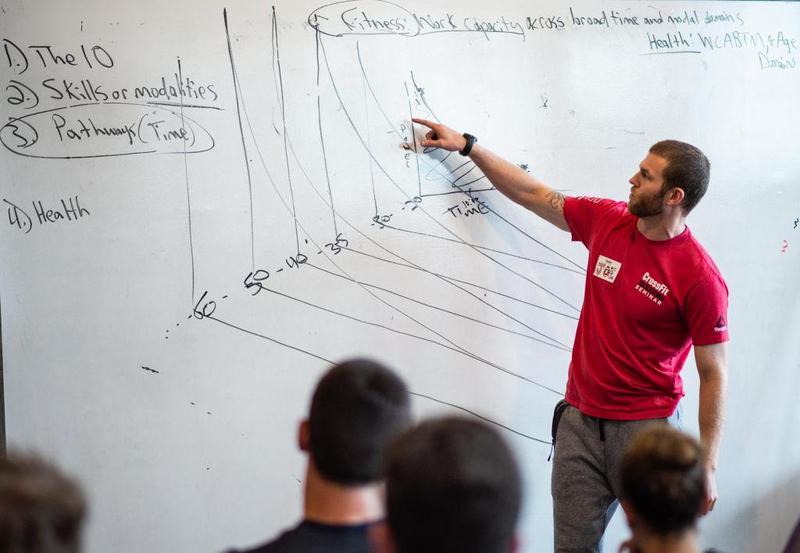
“By tracking the difference in time between workout attempts, we are looking at changes in power. We did not have to study this much longer to come to this understanding that your collection of workout data points represented your work capacity across broad time and modal domains. This is your fitness.”
It is interesting that I had to venture out of the academic realm to find something so profoundly scientific. Here we have, at long last, a definition founded on something measurable, repeatable and evidence based—the ability to perform work per unit time; i.e., the ability to produce and sustain power.
I hope the average person understands the importance of this conceptual advance. Before Coach Glassman articulated this idea in these terms, there was no scientifically defensible definition of fitness. It did not exist. But now, with fitness defined as work capacity across broad time and modal domains, we have a framework for understanding physical function, health, well-being, physiology, biochemistry and molecular biology in a way that was not previously possible. Overall, I would argue that presenting a useful definition of fitness is one of the great contributions to the human health sciences in the current era—probably in history.
As is often the case for major scientific breakthroughs, Coach Glassman’s definition of fitness is elegant in its simplicity: Work done per unit time is power. When that work is done by a person, we are discussing human power output; i.e., human performance. Therefore, it is logical to define an individual’s capacity to do physical work in a given amount of time as his or her fitness for that specified time domain. A broad and generally inclusive definition of fitness must include all possible exercise durations and modalities. Thus, it is perfectly tenable to define fitness as work capacity over broad time and modal domains. The definition is rigorous and scientifically sound.
Returning to the definitions available from the exercise-science literature, we see no such rigor. Instead, we see the term “fitness” used most frequently without having first been defined, and when we do see a definition, it is fraught with fallacy and therefore not particularly useful.
About the Author: Dr. Nathan Jenkins is a tenured professor of exercise physiology at the University of Georgia. He conducts research and teaches courses on exercise, obesity and cardiometabolic disease. He began CrossFit in January 2015 and obtained a CrossFit Level 1 Trainer credential in 2017.